

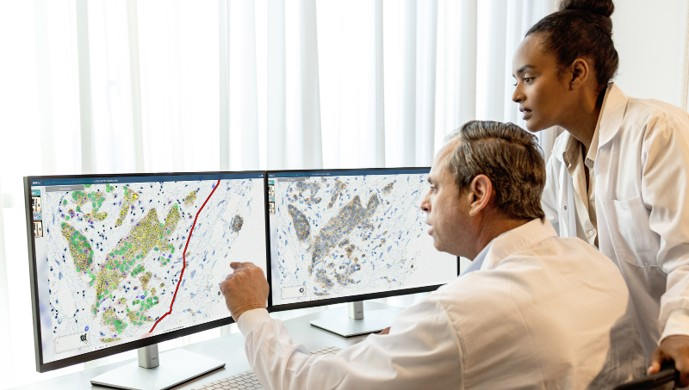
BOSTON, Mass. — Ibex Medical Analytics said it has expanded its biopharma business, extending its AI-powered pathology platform beyond late-stage biomarker development into earlier translational research, biomarker discovery, and clinical trial efficiency optimization.
The company said the expansion builds on its existing collaborations in late-stage biomarker programs and is designed to support exploratory, preclinical, and clinical evidence generation. Ibex added that the platform provides a scalable foundation for future companion diagnostic development as drug developers increasingly seek precision-driven approaches in oncology.
Ibex’s AI pathology platform is currently deployed across more than 50 health systems worldwide and is used in collaboration with major industry organizations. With the expansion, the company said its technology can now support biopharma partners earlier in the drug development lifecycle, helping address the growing complexity of modern oncology therapies.
“In an era where modalities like antibody-drug conjugates, immune-modulating agents, and molecularly guided therapies are reshaping oncology, the field needs biomarkers that match the complexity of our treatments and enable adequate patient selection,” said Paolo Tarantino, M.D., research and clinical fellow at Dana-Farber Cancer Institute and Harvard Medical School. “AI-based biomarker platforms can integrate multiple dimensions of cancer biology in a rapid, objective, and reliable way, offering a terrific opportunity to enhance treatment tailoring. This platform has the potential to transform both early and late drug development, further accelerating drug development and ensuring precision in oncology.”
As part of the expansion, Ibex said it is introducing new and enhanced analytical modules focused on high-priority therapeutic areas. These include tools for quantifying HER2 low and HER2 ultra-low expression, with new data presented at the San Antonio Breast Cancer Symposium in December showing enrichment of true amplified cases within equivocal ranges. Additional modules focus on tumor microenvironment analysis in rare histologic subtypes of common cancers, as well as emerging AI-based biomarkers supporting antibody-drug conjugates, bispecific antibodies, and immune-oncology strategies.
The company said the modules are developed under ISO 13485-aligned design controls, built within an in vitro diagnostic–ready architecture, and supported by versioned pipelines and audit trails designed to meet global regulatory expectations.
“Pharma needs partners that can support biomarker innovation from the earliest exploratory work to fully regulated companion diagnostic programs,” said Joseph Mossel, co-founder and chief executive officer of Ibex Medical Analytics. “With our proven execution in late-stage development including FDA and CE-IVDR clearances, and as we strengthen our translational capabilities, we are uniquely positioned to accelerate drug development pipelines and improve evidence quality worldwide.” (Source: IANS)