

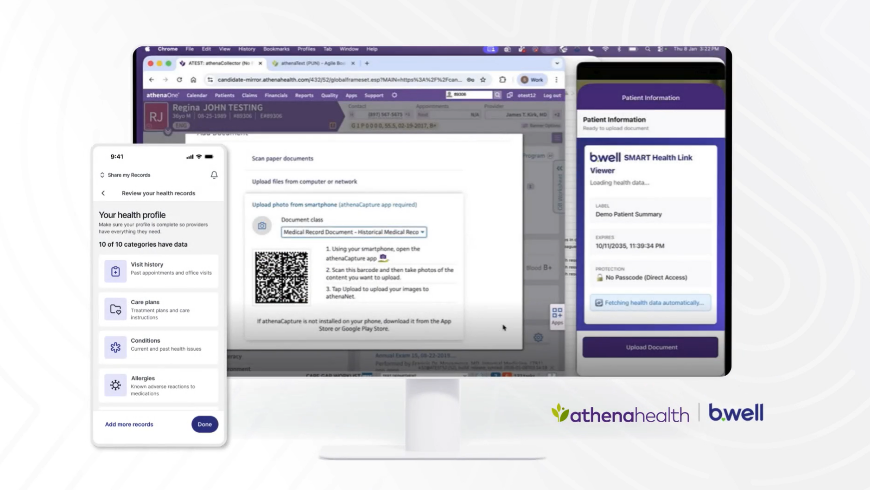
BOSTON– athenahealth and b.well Connected Health said they have introduced a new point-of-care workflow that allows patients to securely share their health information digitally during clinical intake, eliminating the need for paper forms, faxes, or multiple patient portal logins. The companies said a broader rollout of the capability is expected in 2026.
The new workflow is intended to advance interoperability goals set by the U.S. Department of Health and Human Services and the Centers for Medicare & Medicaid Services, including the Health Tech Ecosystem Initiative’s effort to replace manual intake and fragmented data exchange with patient-directed digital tools, an initiative known as “Kill the Clipboard.”
“Your health data should follow you, not the other way around,” said Sam Lambson, vice president of data and ecosystem platform for athenahealth. “This collaboration shows what’s possible when healthcare technology puts patients in control of their data and removes friction for providers.”
Under the new process, patients visiting practices that use athenaOne, athenahealth’s cloud-based platform for electronic health records, revenue cycle management, and patient engagement, can digitally collect their medical records from multiple sources using apps powered by b.well. Patients select which information they want to share and present it to providers via a QR code during check-in.
Practice staff scan the QR code to securely retrieve the authorized information, review it, and add it directly to the patient’s chart within athenaOne. After the visit, the appointment summary is made available to patients through both the athena patient portal and b.well-powered apps.
The workflow also allows patients to share data from consumer health apps and wearable devices, such as activity information, alongside clinical records when they believe it is relevant to their care.
“Patients shouldn’t have to work around healthcare technology systems to bring their data into care,” said Kristen Valdes, CEO and founder of b.well. “With this approach, they can share exactly what they want, when they want, without losing control of their information.”
Both companies are participants in the CMS Health Tech Ecosystem Initiative, which they joined in July 2025, pledging to support easier and more secure data exchange and patient-centered interoperability. They said the collaboration reflects how those commitments can be applied in real-world clinical workflows.
athenahealth said its single-instance platform enables rapid and secure deployment of new capabilities across its network, while b.well’s platform is designed to help patients aggregate, manage, and share their health information across care settings. The companies emphasized that broad adoption of open, patient-centered data sharing approaches across the healthcare ecosystem will be key to improving care delivery for patients and providers alike.