

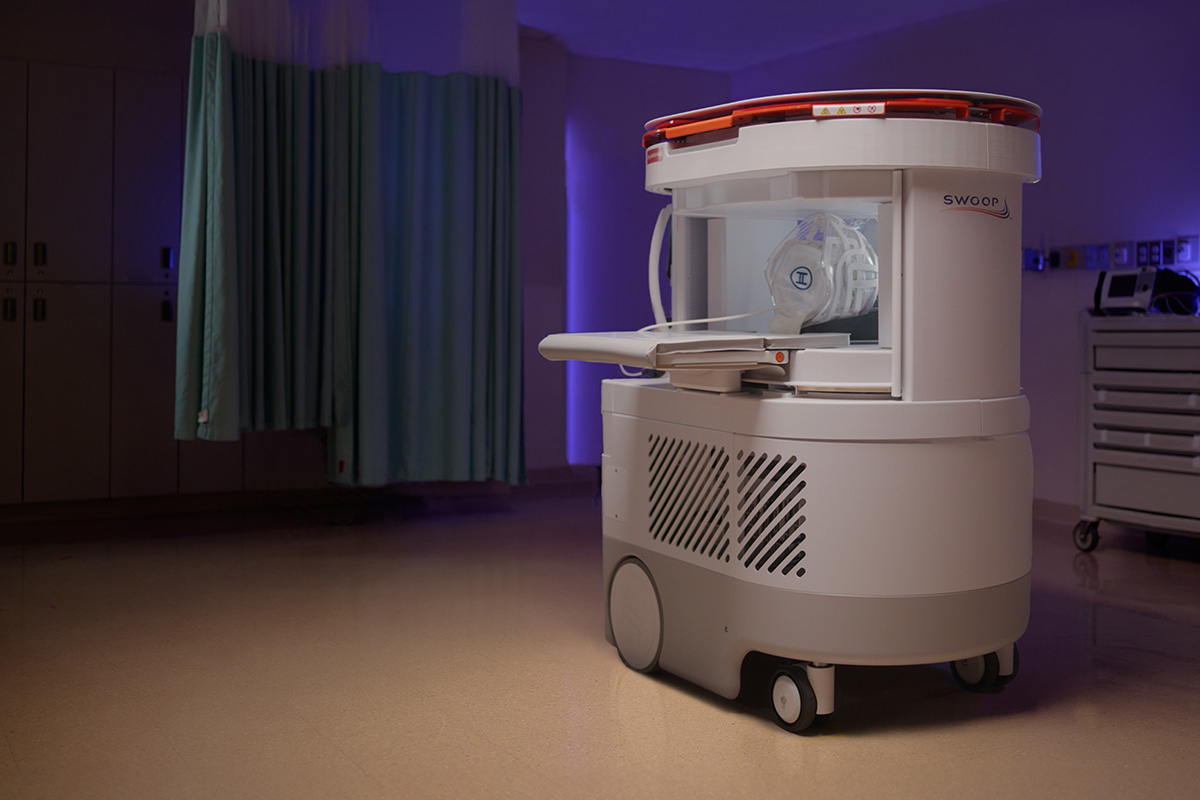
GUILFORD, Conn. — Hyperfine, Inc. announced the publication of new clinical data demonstrating enhanced stroke detection capabilities of its Swoop system, marking the largest dataset to date evaluating the use of an AI-powered portable MRI for stroke diagnosis.
The prospective, multi-center observational study was published in the November issue of Stroke: Vascular and Interventional Neurology and evaluated 95 patients across multiple institutions. The dataset combined findings from the ACTION PMR study conducted at Massachusetts General Hospital and Buffalo General Medical Center, along with additional data from Yale New Haven Hospital. Researchers assessed the sensitivity and specificity of ischemic lesion detection using both the original and next-generation Swoop scanners, as well as two diffusion-weighted imaging sequences critical for stroke identification.
According to the study, the next-generation Swoop system, using an advanced multi-directional DWI sequence, demonstrated substantial improvements in diagnostic performance. The system successfully identified ischemic lesions as small as 2.8 millimeters, or 0.15 milliliters, enabling detection of very small strokes. For lesions larger than 1.0 milliliter, the system achieved 100 percent sensitivity and 100 percent specificity. The updated scanner also reduced scan time by approximately 30 percent and showed improved image uniformity across the brain, supporting its use in time-sensitive emergency settings.
“We previously showed that using DWI in combination with FLAIR on the portable MRI system can be used as a ’tissue clock’ for stroke detection, similar to conventional MRI. With this study, we took the next step and evaluated the capability of ultra-low-field MRI with advanced, multi-directional DWI sequences to detect very small ischemic lesions,” said Taylor Kimberly, MD, PhD, Chief of the Neurocritical Care Division at Mass General Brigham. “The results show that the next-generation portable MRI system with a multi-directional DWI sequence enables detection of very small strokes in a clinically feasible timeframe. The portable MRI system’s ability to detect clinically relevant strokes opens new possibilities for transforming stroke diagnosis and management—bringing timely evaluation to more patients and care settings than ever before.”
Hyperfine said stroke detection represents a key driver of the Swoop system’s expansion into emergency departments. The company noted that the improved diagnostic performance, combined with shorter scan times, supports the integration of portable MRI into acute care workflows.
“Stroke detection represents a critical driver of the Swoop system’s expansion into emergency departments,” said Maria Sainz, President and Chief Executive Officer of Hyperfine. “The results from our next-generation Swoop system, combined with our new, advanced multi-direction DWI sequence that was recently cleared by the FDA, are truly remarkable. This data gives us even greater confidence that the Swoop system can reliably detect clinically relevant strokes, streamline workflows, and further strengthen the value of integrating portable MRI into stroke diagnosis and care.”